
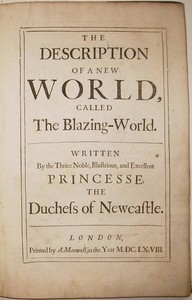
The Description of a New World, Called the Blazing-World by Newcastle
Let's set the scene: London, 1666. While the city was rebuilding from the Great Fire, Margaret Cavendish, the Duchess of Newcastle, was quietly publishing one of the strangest and most ambitious books of the century. It wasn't a diary or a poem, but a full-blown work of speculative fiction.
The Story
The story starts with a familiar feel—a young lady is stolen away by a scheming merchant. Their voyage goes horribly wrong near the North Pole. But instead of a tragic end, the ship passes through a portal into a starry, luminous new world inside our own. The lady is immediately recognized as a divine being by the inhabitants: intelligent humanoid creatures who are part bear, part bird, part worm, and part fish. They crown her their absolute Empress. With unlimited power, she doesn't just relax. She gets to work. Her first command? To gather all the world's greatest scientists and philosophers—each type represented by a different species—and question them about the fundamentals of nature, from why the sun shines to how life begins. Dissatisfied with being the sole human ruler, she performs a spiritual ritual to bring the soul of the 'Duchess of Newcastle' (yes, the author) to be her 'Platonic friend.' Together, they rule, create new arts and sciences, and eventually defend their world from invaders from our own Earth.
Why You Should Read It
Reading this feels like uncovering a secret. Cavendish wasn't just making up a fun adventure. She was using this fantasy world to argue for women's intellectual authority, critique the Royal Society of scientists (all men), and imagine a society built on rational inquiry led by women. The sheer audacity of writing herself into the story as the Empress's essential co-ruler is breathtaking. It's a powerful act of literary self-creation. The prose is dense and the concepts are big, but there's a playful, defiant energy that crackles through it. You can feel her delight in building a world where she gets to ask all the questions and provide her own answers.
Final Verdict
This book is a treasure for anyone interested in the roots of science fiction, feminist literary history, or just wonderfully weird old books. It's not a fast-paced modern novel; it's a thoughtful, eccentric, and revolutionary thought experiment. Perfect for readers who love uncovering the 'what if' moments in history, for fans of authors like Ursula K. Le Guin who explore society-building, and for anyone who enjoys a story where a woman's curiosity literally reshapes the universe. Approach it with an open mind, and you'll be rewarded with a glimpse into the brilliant, blazing imagination of a true original.
This text is dedicated to the public domain. It is available for public use and education.
Sarah Taylor
9 months agoIf you're tired of surface-level information, the author clearly has a deep mastery of the subject matter. A refreshing and intellectually stimulating read.
Paul Martinez
1 year agoThis digital copy caught my eye due to its reputation, the emphasis on ethics and sustainability within the topic is commendable. This should be on the reading list of every serious professional.
Donald Jones
1 month agoHaving followed this topic for years, I can say that the level of detail in the second half of the book is truly impressive. This is a solid reference for both beginners and experts.


Emily White
4 months agoIt’s rare to find such a well-structured narrative nowadays, the practical checklists included are a great touch for real-world use. It’s hard to find this much value in a single source these days.