
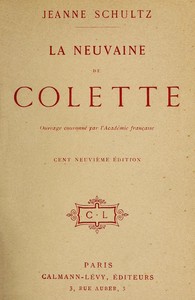
La neuvaine de Colette by Jeanne Schultz
Published in 1902, La Neuvaine de Colette is a brief but intense novel that unfolds almost entirely within the confines of its protagonist's mind and a small chapel.
The Story
The plot is simple on the surface. Colette, a young woman in a provincial French setting, is in love with a man named Lucien. Their relationship is impossible or unspoken, bound by the strict social rules of the time. Feeling she has no other recourse, Colette begins a 'neuvaine'—a traditional nine-day series of prayers—dedicating her devotion to Saint Anthony, hoping for a miracle that will bring Lucien to her. Each day of the novena forms a chapter. We follow Colette's internal journey as she kneels in the church, her prayers slowly mixing with her own swirling thoughts, memories of Lucien, flashes of jealousy, and growing waves of doubt. The tension builds not from external events, but from the question of whether her faith will hold, or if her very human heart will betray the sacred purpose of her vow.
Why You Should Read It
What grabbed me was how real Colette feels. Jeanne Schultz doesn't paint her as simply pious or simply lovesick. She's a tangled mix of both, and that makes her fascinating. You feel for her struggle. In an era when women's inner lives and desires were often ignored or suppressed, this book gives a powerful voice to that silent conflict. The 'neuvaine' becomes a brilliant device—a socially acceptable container for all this roiling emotion. It's a story about the limits of faith when faced with raw human longing, and about the creative, sometimes desperate, ways people find to cope with powerlessness. It's psychologically sharp, and for a book over a century old, it reads with a clarity that's really striking.
Final Verdict
This is a perfect pick for readers who love character-driven stories and historical fiction that focuses on emotion rather than grand events. If you enjoyed the interiority of novels like The Yellow Wallpaper or the quiet tension of an Alice Munro story, you'll find a kindred spirit here. It's also a great, accessible entry point into French literature from this period—it's short, direct, and deeply human. Don't expect a sweeping romance or a thriller; instead, prepare for a thoughtful, poignant, and beautifully restrained portrait of a heart in quiet crisis.
This historical work is free of copyright protections. It serves as a testament to our shared literary heritage.
Richard Clark
4 months agoI started reading out of curiosity and it manages to explain difficult concepts in plain English. Exactly what I needed.
Charles Lee
10 months agoI didn't expect much, but the author's voice is distinct and makes complex topics easy to digest. Absolutely essential reading.
Oliver Williams
11 months agoI had low expectations initially, however the atmosphere created is totally immersive. One of the best books I've read this year.








Elizabeth Lopez
7 months agoI took detailed notes while reading through the chapters and the practical checklists included are a great touch for real-world use. A trustworthy resource that I'll keep in my digital library.