About 453 minutes
The Further Adventures of Robinson Crusoe — Reading Companion
Science Fiction Utopias
103,987 recorded words. 90 minutes difference from this book's estimate.
View Gutenberg source #561
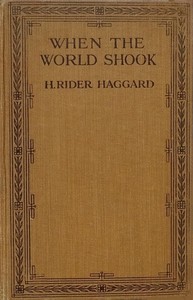
When the World Shook Being an Account of the Great Adventure of Bastin, Bickley and Arbuthnot — Inside the Classic can be approached with a clearer sense of reading commitment from its source measurements: 124,815 words, 9 hr 3 min estimated reading time, and 29 detected text sections.
The text analysis averages about 19.5 words per sentence, while the detected sections provide another way to judge how the source is divided.
Project Gutenberg metadata also associates the work with “Science fiction,” connecting these edition facts with the source record’s subject description.
Explore this collection
These alternatives are selected using recorded categories and estimated reading time.
About 453 minutes
Science Fiction Utopias
103,987 recorded words. 90 minutes difference from this book's estimate.
View Gutenberg source #561About 335 minutes
Science Fiction Utopias
76,959 recorded words. 208 minutes difference from this book's estimate.
View Gutenberg source #1803About 328 minutes
Science Fiction Utopias
75,313 recorded words. 215 minutes difference from this book's estimate.
View Gutenberg source #1055Search stored excerpts and compare books → Choose by your preferences →
Choices use stored catalog measurements. Estimates vary with reading speed. A shared category is a catalog label, not a claim that two books have the same argument or literary quality.
Search reads excerpt text stored with this catalog and links to its associated Gutenberg record. The connection is stored in the site database; this tool does not recheck that every excerpt is word-for-word identical to that external record. Excerpt search does not cover every chapter and does not verify historical publication dates.
Catalog snapshot checked: 2026-09-25. Coverage: 92 public books, 92 available source excerpts.
Calculated from edition completeness, EPUB availability, text structure and catalogue metadata. Not a user rating.
Total of 100 points, scaled to a 2.5-5.0 range. Editions with an empty description or a missing EPUB file are not scored.
Public-domain source text
The source text is kept in the dedicated reader, separate from this catalogue record and its commentary.
H. Rider Haggard's When the World Shook opens with narrator Humphrey Arbuthnot describing himself and his Devonshire home, the Priory, in a tone that blends personal reflection with a sense of impending destiny. The novel's first chapter establishes Arbuthnot as a man of forty, settled in a landscape of 'red sandstone' and 'great timber trees,' yet poised for an extraordinary departure from this tranquil setting. The author's choice to begin with a detailed self-portrait signals that the story will be filtered through Arbuthnot's sensibilities—his romanticism, his susceptibility to wonder, and his tendency toward introspection. This narrative voice, at once measured and emotionally charged, becomes a key lens through which the fantastic events are rendered believable.
The three protagonists—Arbuthnot, Bastin, and Bickley—are distinguished not only by their professions but by their distinct speech patterns and worldviews. Arbuthnot, the narrator, writes in a flowing, somewhat ornate style, given to emotional exclamations and vivid sensory descriptions. Bastin, the clergyman, speaks in a blunter, more literal manner, often missing subtle cues; his reaction to the water of life—breaking into a hymn and worrying about temperance—reveals a mind that filters the extraordinary through familiar religious frameworks. Bickley, the surgeon, is characterized by his clinical reserve; after drinking the water, he boasts of surgical confidence rather than mystical insight. Haggard uses dialogue to underscore these contrasts, as when Bastin mistakes the water for Apollinaris and Bickley dryly remarks, 'Just the sort of thing you would do.' The interplay of these voices creates a dynamic that is both comic and philosophically rich, grounding the supernatural in recognizable human foibles.
One of the novel's central set pieces—the drinking of the water of life—is rendered through a cascade of sensory details that blur the line between the physical and the transcendent. Arbuthnot describes the water as 'sparkling, like that French liqueur in which are mingled little flakes of gold,' and its taste as 'strong champagne, dashed with Château Yquem.' Yet the effects are not merely gustatory: the water induces a momentary clarity, a 'burning away' of obscurity, and a fleeting telepathic connection with the Lady Yva. Haggard's prose here shifts from concrete description to abstract introspection, as Arbuthnot feels 'wonderful knowledge, wonderful memories and wonderful hopes.' The passage is notable for its restraint—the vision lasts only thirty seconds—and for the way it differentiates the characters' responses: Bickley feels empowered, Bastin becomes tipsy and sings, while Arbuthnot experiences an emotional and intellectual opening. This scene exemplifies Haggard's method of using a single fantastical element to reveal character and theme simultaneously.
When Arbuthnot first encounters the portico of Oro's dwelling, he struggles to categorize its style, noting that it is 'not Egyptian and not Greek,' though it combines the 'solidity' of the former with the 'beauty and grace' of the latter. This inability to classify the architecture mirrors the broader challenge the characters face in comprehending the civilization they have stumbled upon. Haggard uses architectural description to evoke a sense of antiquity and otherness that is both awe-inspiring and slightly unsettling. The carvings are described as 'profuse' and 'rather grotesque,' hinting at a culture whose aesthetic values are alien. By foregrounding Arbuthnot's failure to find a familiar reference point, the author emphasizes the limits of the protagonists' knowledge and prepares the reader for revelations that will challenge their scientific and religious assumptions. The architecture thus functions as a silent character, embodying the mystery that the narrative will gradually unfold.
Among the more unexpected elements of the novel is the presence of Tommy, a dog who accompanies the three men on their adventure. Tommy is not merely a pet but an active participant in the story: he 'frisks ahead' excitedly after drinking the water of life, and his behavior is noted alongside that of his masters. Haggard uses Tommy to inject a note of domesticity and humor into the extraordinary proceedings, but also to underscore the universality of the water's effects—even a dog is transformed by it. The inclusion of a canine character also serves to humanize the trio, reminding readers that these are not merely archetypes but individuals with everyday attachments. In a narrative that deals with immense spans of time and cosmic forces, Tommy provides a grounding presence, a link to the ordinary world that the characters have left behind. His presence subtly reinforces the theme that the miraculous can touch even the most mundane aspects of life.
Readers approaching When the World Shook should attend to the way Haggard balances the improbable with the quotidian. The novel's power lies not in the plausibility of its lost world but in the consistency of its narrative voice and the vividness of its character interactions. Arbuthnot's earnestness, Bastin's literal-mindedness, and Bickley's skepticism create a triangulated perspective that allows the reader to experience wonder, doubt, and humor simultaneously. The text rewards attention to small details—a dog's reaction, a misidentified drink, a moment of architectural bafflement—that reveal the author's craft in making the extraordinary feel tangible.
Something about Haggard’s three men stumbling through that ancient, half-waking world stayed with me—the way Arbuthnot confesses his own trembling awe rather than tidy answers. I found a similar ache in Dead Men Tell No Tales — Reading Notes, where the silences between old secrets feel just as heavy. Strange how a story can leave you quieter than it found you.
Answer a few questions and save a private reflection on this device.