
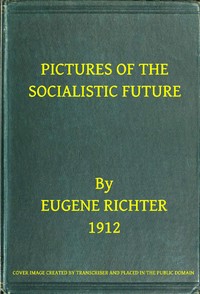
Pictures of the Socialistic Future by Eugen Richter
Ever wondered what a politician from the 1890s thought the future would look like if his opponents won? Eugen Richter gives us his answer in this fascinating, and frankly alarming, work of political fiction.
The Story
The book follows a middle-class German family and their community after the Social Democrats sweep into power. What starts with hopeful promises of equality quickly unravels. The new government seizes private property, from large factories down to the local bakery. They assign everyone jobs and housing, control all newspapers, and ration food. Our main characters, who were once comfortable, find their savings wiped out, their career choices gone, and their daily lives micromanaged by a vast, inefficient bureaucracy. There's no dramatic rebellion or hero's journey—just a gradual, suffocating descent into a gray world where initiative is punished, art dies, and everyone is equally miserable. The "pictures" in the title are vivid snapshots of this failed utopia: endless bread lines, families crammed into assigned apartments, and a chilling state-controlled press.
Why You Should Read It
Look, this isn't a subtle book. Richter was a liberal politician writing a polemic against socialism, so his bias is front and center. But that's what makes it so compelling as a historical artifact. Reading it feels like listening to a passionate, fearful warning from another century. You don't have to agree with his politics to be gripped by his imagination. He predicts things like the abolition of money, state-controlled art, and the crushing of individual liberty with an eerie clarity. It's less about complex characters (they're pretty simple) and more about the terrifying logic of the system he envisions. It makes you think hard about the trade-offs between security, freedom, and equality—conversations we're still having today.
Final Verdict
This book is a hidden gem for anyone interested in political science, history, or the roots of dystopian fiction. It's perfect for readers who enjoyed Orwell's 1984 and want to see one of its intellectual ancestors. It's also surprisingly accessible; the writing is clear and the scenarios are straightforward. Don't read it as an accurate prediction, but as a powerful expression of one man's fears about where his world was heading. You'll come away with a deeper understanding of the fierce debates that shaped the 20th century, and maybe a few shivers down your spine.
This work has been identified as being free of known copyright restrictions. You can copy, modify, and distribute it freely.
Jessica Davis
1 year agoHelped me clear up some confusion on the topic.
Michael Smith
8 months agoBased on the summary, I decided to read it and the author's voice is distinct and makes complex topics easy to digest. I would gladly recommend this title.
Donna Robinson
11 months agoClear and concise.
Charles Torres
9 months agoThis book was worth my time since the pacing is just right, keeping you engaged. Truly inspiring.

John Brown
1 year agoText is crisp, making it easy to focus.