About 72 minutes
The Man Who Could Not Lose — Background and Themes
Fantasy Juvenile Worlds
16,457 recorded words. 25 minutes difference from this book's estimate.
View Gutenberg source #1760
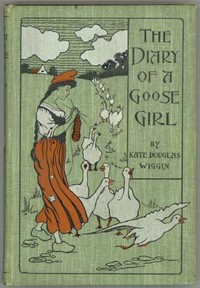
The source record for The Diary of a Goose Girl — Themes and Context measures this digital text at 22,083 words, 1 hr 37 min estimated reading time, and 3 detected text sections.
The text analysis averages about 23.2 words per sentence, while the detected sections provide another way to judge how the source is divided.
Project Gutenberg metadata also associates the work with “England -- Juvenile fiction,” connecting these edition facts with the source record’s subject description.
Explore this collection
These alternatives are selected using recorded categories and estimated reading time.
About 72 minutes
Fantasy Juvenile Worlds
16,457 recorded words. 25 minutes difference from this book's estimate.
View Gutenberg source #1760About 64 minutes
Fantasy Juvenile Worlds
14,650 recorded words. 33 minutes difference from this book's estimate.
View Gutenberg source #862About 48 minutes
Fantasy Juvenile Worlds
10,871 recorded words. 49 minutes difference from this book's estimate.
View Gutenberg source #759Search stored excerpts and compare books → Choose by your preferences →
Choices use stored catalog measurements. Estimates vary with reading speed. A shared category is a catalog label, not a claim that two books have the same argument or literary quality.
Search reads excerpt text stored with this catalog and links to its associated Gutenberg record. The connection is stored in the site database; this tool does not recheck that every excerpt is word-for-word identical to that external record. Excerpt search does not cover every chapter and does not verify historical publication dates.
Catalog snapshot checked: 2026-09-25. Coverage: 92 public books, 92 available source excerpts.
Calculated from edition completeness, EPUB availability, text structure and catalogue metadata. Not a user rating.
Total of 100 points, scaled to a 2.5-5.0 range. Editions with an empty description or a missing EPUB file are not scored.
Public-domain source text
The source text is kept in the dedicated reader, separate from this catalogue record and its commentary.
The narrator of The Diary of a Goose Girl announces herself with a mock-heroic flourish: she is a poultry-maid, a shepherdess, a tender of Belgian hares, but she “particularly fancy[s] the rôle of Goose Girl” because it recalls German fairy tales. This self-conscious adoption of a literary identity sets the tone for a diary that blends whimsy with sharp-eyed reporting. The opening pages show a woman who cuts herself loose from civilisation with a note that reads “I am very tired of people” and a vow never to be taken alive, yet she carries “plenty of money” in her purse—an unromantic detail that undercuts the pastoral fantasy even as she embraces it.
The narrator’s voice is the book’s chief engine. She describes her arrival at Barbury Green with a “fine, dizzy, muddle-headed joy” and compares her discovery to a “Columbus thrill.” The diction is deliberately literary—she quotes Stevenson, alludes to Arcadia—but it is undercut by practical asides. When she sends for clothing, she specifies “nothing but shirts and skirts,” and when she settles in, she notes that her lodging is “too small to be printed on the map.” This oscillation between romantic self-dramatisation and wry practicality gives the prose its particular texture. The diary form allows her to address the reader directly, withholding the village’s exact location so that “you may not miss that Columbus thrill.”
The excerpts include a long speech from Mrs. Heaven, the landlady, who recounts her former life as a butcher’s wife. Her monologue is a comic set piece: she complains that “nobody satisfied with their meat” and that customers always want “fine joints” when “it’s against reason and nature that all joints should be juicy.” The rhythm of her speech—the repeated “always,” the shift from practical grievance to moralising (“if people would think more of the great ’ereafter”)—creates a distinct character voice. The narrator does not comment on this speech; she simply records it, letting Mrs. Heaven’s own words reveal her blend of weariness and philosophy. This technique recurs in the depiction of the geese, where the narrator anthropomorphises them with mock-seriousness.
The longest excerpt recounts the story of Sir Muscovy Drake, Lady Blanche, and Miss Malardina Crippletoes. The narrator frames it as “the true story” and gives the ducks formal names and titles, treating their social dynamics as a kind of avian drama. Sir Muscovy and Lady Blanche “disdained to notice the rest of the flock” and formed a “close friendship,” while the lame duck is persecuted until Sir Muscovy intervenes. The description of his rescue—he “fell upon the other drake” and then “seemed to whisper to her”—is precise in its physical detail but also clearly allegorical. The narrator’s tone hovers between scientific detachment and fairy-tale moralising, a balance that characterises the book’s treatment of its animal subjects.
The book is divided into chapters dated from July 1 onward, but the excerpts show that the diary is not a strict daily record. The narrator skips time, inserts set pieces like the duck story, and occasionally breaks into asterisks to mark a shift. The opening chapter establishes the premise—a woman fleeing society—but the subsequent entries focus less on her own story and more on the life of the farm. The geese, ducks, and hens become characters in their own right, and the narrator’s voice recedes into that of an observer. This structural choice, visible even in the partial text, suggests that the diary is less a confession than a series of sketches, unified by the narrator’s wry, affectionate attention to the creatures around her.
Readers approaching The Diary of a Goose Girl should expect a work that is neither a straightforward novel nor a naturalist’s journal. The narrator’s voice is the constant thread, but she is as interested in the speech of Mrs. Heaven as in the courtship of ducks. The diary form gives the book a loose, episodic structure; each entry rewards attention to the specific details of gesture, dialogue, and setting. The excerpts suggest a book that finds its comedy and its pathos in the gap between the narrator’s romantic self-image and the mundane realities of goose-tending.
Sometimes a book stays with you not for its plot, but for the gentle way it watches its own narrator—that playful self-awareness in The Diary of a Goose Girl reminded me of the quiet, wry companionship I found in The Wheels of Chance: A Bicycling Idyll — Background and Themes. Both feel like a friend chuckling softly at their own follies.
Answer a few questions and save a private reflection on this device.