About 264 minutes
The Story of a Bad Boy — Reading Companion
Fantasy Juvenile Worlds
60,601 recorded words. 0 minutes difference from this book's estimate.
View Gutenberg source #1948
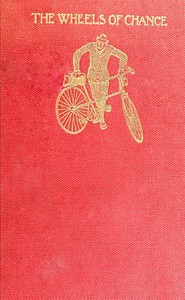
For The Wheels of Chance: A Bicycling Idyll — Background and Themes, the stored edition analysis reports 60,674 words, 4 hr 24 min estimated reading time, and 43 detected text sections.
The text analysis averages about 13.5 words per sentence, while the detected sections provide another way to judge how the source is divided.
Project Gutenberg metadata also associates the work with “England -- Social conditions -- 19th century -- Fiction,” connecting these edition facts with the source record’s subject description.
Explore this collection
These alternatives are selected using recorded categories and estimated reading time.
About 264 minutes
Fantasy Juvenile Worlds
60,601 recorded words. 0 minutes difference from this book's estimate.
View Gutenberg source #1948About 287 minutes
Fantasy Juvenile Worlds
65,971 recorded words. 23 minutes difference from this book's estimate.
View Gutenberg source #372About 208 minutes
Fantasy Juvenile Worlds
47,625 recorded words. 56 minutes difference from this book's estimate.
View Gutenberg source #1696Search stored excerpts and compare books → Choose by your preferences →
Choices use stored catalog measurements. Estimates vary with reading speed. A shared category is a catalog label, not a claim that two books have the same argument or literary quality.
Search reads excerpt text stored with this catalog and links to its associated Gutenberg record. The connection is stored in the site database; this tool does not recheck that every excerpt is word-for-word identical to that external record. Excerpt search does not cover every chapter and does not verify historical publication dates.
Catalog snapshot checked: 2026-09-25. Coverage: 92 public books, 92 available source excerpts.
Calculated from edition completeness, EPUB availability, text structure and catalogue metadata. Not a user rating.
Total of 100 points, scaled to a 2.5-5.0 range. Editions with an empty description or a missing EPUB file are not scored.
Public-domain source text
The source text is kept in the dedicated reader, separate from this catalogue record and its commentary.
The novel opens not with a bicycle but with a counter: the reader is invited, in the second person, to imagine entering the Drapery Emporium of Messrs. Antrobus & Co. in Putney on 14 August 1895. There, the central figure—Mr. Hoopdriver—would serve you with a bow, protruding chin, and enormous cuffs, his manner devoid of pleasure. This precise, almost ethnographic attention to the draper's trade establishes a narrator who is both omniscient and archly aware of the reader's presence. The catalog subjects list 'England -- Social conditions -- 19th century -- Fiction' and 'Cycling -- Fiction,' but the excerpts show that cycling is less a theme than a vehicle for social comedy and a release from the confines of shop life.
The opening chapter, 'The Principal Character in the Story,' devotes several paragraphs to the minutiae of Hoopdriver's trade: the types of fabric he would show (huckaback, dimity, cretonne) and the choreographed movements of his service. The narrator's tone is mock-heroic, treating a draper's assistant as a figure of epic importance while undercutting him with details like 'largish knuckles' and a 'spasmodic' grip on a chair. This voice—knowing, slightly condescending, yet sympathetic—permeates the excerpts. It addresses the reader directly ('if you (presuming you are of the sex that does such things)') and occasionally withholds information, as when it promises 'a little surprise I have prepared for you' regarding the stepmother. The catalog subject 'England -- Social conditions -- 19th century' is thus rendered not through broad social commentary but through the precise, ironic observation of a single draper's existence.
The excerpts reveal a subplot involving a young woman named Jessie, her stepmother Mrs. Milton (who writes under the pseudonym 'Thomas Plantagenet'), and a man named Bechamel. The narrator describes Mrs. Milton as 'a charming woman' whose reviewers 'used to write invariably,' and notes that she brought Jessie up so carefully that she never let her read her own daring book, 'A Soul Untrammelled'—which Jessie naturally read. This layered irony—a stepmother who is a novelist of advanced views yet conventionally respectable—complicates the catalog's simple social conditions. The narrator explicitly moralises about selfishness: 'There is very little deliberate wickedness in the world. The stupidity of our selfishness gives much the same results.' The elopement is presented as a comic misunderstanding, with Hoopdriver inadvertently involved, but the narrator's digressions on Mrs. Milton's literary circle and her 'properest spirit' suggest a satirical interest in the gap between public reputation and private behaviour.
Though the catalog lists 'Cycling -- Fiction,' the excerpts show the bicycle as a means of liberation and a source of farce. Hoopdriver's ride is described in chapter titles like 'The Riding Forth of Mr. Hoopdriver' and 'The Shameful Episode of the Young Lady in Grey.' The narrator notes that Hoopdriver is 'proud of himself in a somnolent way for these incomparable follies' and worries about being 'locked up the very first thing to-morrow morning for the rape of the cycle'—a phrase that plays on the legal term for theft. The bicycle enables chance encounters and mistaken identities, but the excerpts give little sense of the landscape or the mechanics of cycling; instead, the focus is on Hoopdriver's inner life and the social comedy of his interactions. The novel's subtitle, 'A Bicycling Idyll,' is thus ironic: the idyll is constantly interrupted by anxieties about class, propriety, and the consequences of impulsive freedom.
Readers should attend to the narrator's asides and the way Wells uses the bicycle as a prop rather than a subject. The excerpts suggest that the novel's interest lies less in cycling than in the collision between a draper's mundane reality and the romantic fantasies he projects onto the road. The stepmother's literary career and the elopement plot are handled with a lightness that undercuts any straightforward social critique. Treat the catalog subjects as starting points, not summaries: the England depicted here is filtered through a distinctly ironic, self-conscious narrative voice that is the book's true subject.
Reading again how Mr. Hoopdriver pedals away from his ordinary life, I found myself thinking of that other quiet escape in Where the Blue Begins — Key Ideas to Explore. Both have that sense of a horizon pulling someone forward, not from drama, but from a gentle ache for something beyond the daily round. It’s a comforting thought, that restlessness.
Use these questions to collect your thoughts before moving on.